Here is an interesting video link (click on the word Talent) that helps explain a bit about learning and talent. I'll use this to go into a bit of detail around
LTAD and how learning is simple, but mastery of skill a bit difficult.
In
The Talent Code author
Dan Coyle breaks down some pretty basic concepts to show how young people can
develop talent to exceptional levels. The discussion is on how talent is developed and an explanation of how
Masters have been created in various fields ie sports and the arts. I will address this as it relates to developing skill in general and also as it relates to taking skill to an exceptional level.
We have to start with an understanding of the brain and the central nervous system. When an activity is done for the first time, ie throw a ball, it is a result of a series of commands along the nervous system that begin in the brain. The pathways for that command are new and the process takes time. Imagine walking through deep power snow from your back door to the centre of your yard; you are making the path as you go. When an activity is repeated it becomes more fluid since the nervous system has modified itself, built a pathway, by creating myelin around the nerve or axon involved in the action. That myelin supply increases every time the activity is repeated and the myelin speeds up the communication along the way, makes everything happen more smoothly. Imagine that walk through the snow after it has been done 10 times, the path exists and there is less "creating" and more "traveling". After 100 walks along that snowy path it will be hard packed and firm, no more sinking into the snow with each step, you will travel the path in a fraction of the time.
This is where
Practice comes into the picture because practice creates pathways for the message and speeds up the process with new myelin. When discussing this in the video link here Coyle uses
Practice, Practice, Practice as the first factor in developing talent. Why is it number 1 and repeated over and over? Because the repetition creates the talent physically, by changing the person. That is pretty straightforward but also pretty shocking to many.
This is not to say that everyone will have the same skill set if they apply the same practice. No, it means that nobody will be a
Master without developing what they have. It was long ago established that to become a master of any skill there is an investment of 10,000 hours of practice that must be put into that activity. This number is not really in debate, it is accepted as the 10 year/10,000 hour rule in music, dance, sport and anything similar.
This is where sport is helped incredibly by following a Long Term Athlete Development (
LTAD) protocol based on science. Coaches are told what skills and systems are to be taught at each developmental stage AND, here is the key point, HOW OFTEN to train those skills or systems.
Practice will help an athlete learn a skill and develop
physically literacy. It is
Practice, Practice, Practice will help an athlete
Master a skill and become an expert. That is why anyone hoping to stand on a podium must train the sport skills 6-8 times per week from an early age ie early teens, to reach that level while still in their physical prime.
Let's move on to the other components of talent development that have been identified as they have a great influence on performance for all levels of athletes, not just
Masters. Coyle lists
Great Coaching as the second thing that is needed to develop talent and I can't argue with that. It's what defines great coaching that will surprise many and I won't debate it here as anyone that knows me knows where I stand on Coyle's observations in the video that great coaches are "mild, laid back, intensely watchful". When he said the words "intensely watchful" it made me smile.
What I want to remind you is that Coyle is talking about great coaches who develop talent. He isn't describing what is a great coach in the NFL or NHL where great talent is already present. Those coaches are managing that talent and the focus is often on systems of play rather than skills in those systems. This is a key difference as it also applies to amateur sport and national teams. Practices I design for developing athletes are quite different from what a National Team would need if they were senior players pursuing a podium finish. This is why Canada struggles in many sports. The best athletes are coming to national teams way before they are
Masters and they are doing tactics and multi-skilled activities before they are ready to excel at them.
LTAD is designed to address that fractured system.
When he is discussing
Great Coaching Coyle mentions the "small, really intense, corrections" that he observes. This is important because the
intense quality is affected greatly by the third factor influencing developing talent -
Total Concentration. How many times does a coach deliver a message when there is no concentration or marginal concentration? That is where environment can make a huge difference in learning. A classroom with mayhem and noise, a gym with multiple activities, a pool with aquasize music blaring over a water polo coach instruction, all of these influence an athletes ability to focus on the small correction that is being demanded of the student/athlete.
After learning about the 3 factors that influence talent development it is much easier to understand the movement to
LTAD in sport, world wide. Placing athletes in programs that reflect their developmental goals ie general physical literacy or literacy toward mastery, helps put them in the proper learning environment. We can also see why just training at anything
more is not enough. It has to be "practice with a purpose" and that includes
Great Coaching and
Total Concentration.
This understanding of how talent is developed helps to see the value of different streams of activity. When Canada creates a sport system that has a top level named "
Own the Podium" you can see that this refers to the motivation in the training to become a Master. It is not a boastful "we're gonna own the podium" type of label. It is referring to their goal, they want to own the podium through hard work that equals or passes that of their competitors; the point of the effort is to be one of the best. It is also possible to see how developing athletic skill and physical literacy in children does not have to be measured by wins or losses. What is important is the performance relative to what has been practiced or learned.
This topic introduces opportunities to go into some detail about what age group competition should look like, how the development of team skills relate to myelin in the brain and the psychology associated with this perspective of learning. That will come at another time.

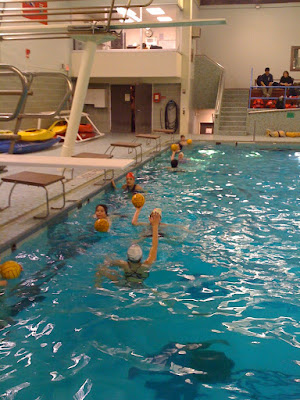 The picture above shows some of the pairs along the wall passing, others are swimming and out of the picture. I had to switch partners after about 5 or 6 minutes when I could see which 12U boy was unable or unwilling to listen to his mentor. After that adjustment we had pairs that all found a way to cooperate on the task the older player set for them. The change in focus of the young players in this situation actually surprised me in a big way. Hanika, in the red hat above, has a good deal of patience and worked the whole time with the youngest boy, Aidan. At 8 he is not confident that he can repeatedly pass the ball in a pair and it took some time for Hanika to get him on task. By the end of the session he was able to do almost 50 passes without dropping the ball and that is about 40 more than he has ever shown us before.
 The really amazing shift though was with Zacharia, above on the right. He really responded well to Sam who was determined to; 1) not swim at all, 2) not be outdone by any other mentor. Zach has a tendency when catching the ball to lay out on his back and wait for it to drop from the sky into his hand as he sinks. This makes his passing partner want to lob the ball more and more softly which negatively reinforces the poor catching position. Sam realized this and worked patiently to find the strength, power and arch of a pass that Zach could absorb without laying on his back. The end result, after about 15 minutes together, was these 2 passing the ball 300 times without dropping it.