Saturday, June 5, 2010

Athletes and families Misled by Swim Clubs

The title to this blog has been changed and the word "abuse" has been removed. That is because Water Polo Canada and Manitoba Water Polo are having to deal with complaints from swimming about my opinions (as a career club coach) and that was not my intent. Those swim organizations refuse to talk to me directly. The content of the blog remains due to the way many Canadian Swim clubs force pre-teen specialization that goes against sport science. I will do an additional blog later on why I decided to change the word abuse in my title as it relates to their LTAD.

I say "defies science" and I will quote from the Swim Canada LTAD document later to specify what I am talking about. This topic has come up because I coach a few young water polo players ie 14U who are 2 sport athletes and get pressure from swimming to do just one sport (swimming) and drop water polo, even if they came to swimming to improve water polo. Of course, all sport science data tells coaches and parents that multiple sports are advisable for a 12-14 year old, that specialization is to be avoided and that balance and physical literacy is important. When a swim coach tells a parent their child is "really good" and should be in group "X" or program "Y", based on their skill, it bullies them into following for fear of failing their child. It's bullying because their own LTAD documents say what they're doing is wrong.

Any coach who ignores the sport science from Sport Canada and their national governing body, simply to keep kids away from other sports or to generate more program revenue, is operating in ethical darkness where they can never defend their actions. I don't say this as a general dismissal of speed swimming, I say it in response to what a few athletes I coach bring to me in tears or frustration. Maybe specifics are needed.

Today I had a 12 year old in tears at the pool thinking she had been to her last water polo practice because her future swim coach had forbidden her to break ranks and miss practice to play a second sport. That is, the swim practices that include 13.5 hours of pool time per week are 100% mandatory for a young girl not yet 13. Let's look at what the Swim Canada LTAD says about that, and I'll quote.

Speed Swimming - Train to Train

- Enjoying a lifestyle of sport and activity
- Chronological ages - Female: 11 to 14 Male: 12 to 15

Amount of physical activity, including non-swimming:
-
6-12 sessions per week
-
60-120 minute sessions
- Pool time (hrs): 12-24
- Participation in 1-2 other sport activities through a year

Let's look at that introduction, it speaks volumes. The amount of physical activity is 12-24 hours per week and it clearly includes "non-swimming" in that equation. By mentioning non swimming it makes it perfectly clear that there is other activity to be accounted for. There is even a breakdown of how many other sports should be part of the athletes routine (ie 1-2). This is from Sport Canada, based on credible sport science, and delivered to clubs through Swim Canada. There is nothing here created by me or by water polo, I am just writing about a dysfunction in Canadian swimming that everyone can see for themselves if they are not afraid to look.


Let's hold a local swim clubs training load for a 12-13 year old girl up to their sport's national LTAD;

TAG group swimming - 8 pool sessions/week and 13.5 hours,

NAT group swimming - 9 pool sessions/week and 16 hours.

Both groups have total training volume that falls within the time and frequency stated in the LTAD but, they do it IN ONE SPORT! That is early specialization and it leads to injury and burn out while preventing physical literacy. How can a 12 year old girl possibly know who she will be at 19, what her body will eventually be like (height, muscle make up, flexibility) what her personality and interests will be? Without knowing these things about themselves they are being asked to narrow focus much too soon.


How difficult would it be for a swim club to work with a water polo club to provide 6-8 hours per week of training in each sport for 12 - 14 year old kids? Not very, since I have been open to this for over a decade if anyone wants to work with me on it. That would provide 12-16 hours per week in a pool, just like the swim clubs dictate now, but it would be balanced over 2 sports that have complimentary but not duplicate training. This would prevent burn out, encourage greater physical literacy and provide athletes more options for the future as their skills and physical growth define a path toward sport success.


One of the key differences in our community right now is that I am working with athletes and families to find pathways to success. I offer permission to explore a second sport during a water polo season (and a 3rd in summer!) and try to have dialogue about these meshing with water polo. By contrast, swim clubs demand that swimmers follow a narrow program focus and refuse permission to negotiate a 2 sport season. That means any family with a child in swimming will be going against the wishes of the swim club by keeping their child in water polo - even if that is where they came from in the first place.


I could prevent the swim clubs from the strong arm position they take now if Manitoba allowed "unattached" swimmers to enter swim meets (ie from a water polo club). But they can't be part of the sport, and we all know why. Too many records would be held by water polo players, too many relay medals given out to girls wearing suits with zippers. Sad, I always approach coaching as if it were for the kids and their development. Too bad not all sports are willing to do that.


Coming up next, a blog about "what do you get from swimming/water polo if you aren't headed to a National Team?"


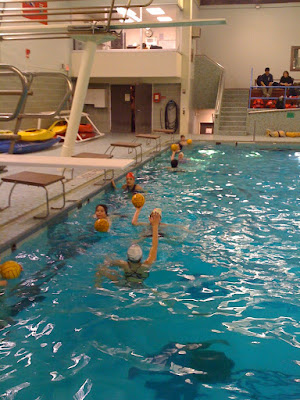


Friday, May 21, 2010

Eggbeater, what is it all about?

I have been doing lots of thinking about the eggbeater kick this season, both reflection and inquiry. It is based partly on the sport science research we are doing and the dialogue with Dr, Marion Alexander at the UofM and Satoru Nakagawa the strength coach from Bushido.

This week I was reviewing joint angles, leg paddles and foot circles as we looked at video of players from various levels of development. There was considerable variety in kick dynamics, no standard biomechanical pattern that had knees, hips, ankles, feet and toes doing the same thing. The basics are the same but the specific technique is not uniform.

When I was asked questions about the ideal, what we are looking for as coaches, when we tried to determine the efficiency of the kick I had to qualify things for the University researchers working with us. The truth is that I have never coached an ideal standard in eggbeater as I never see the legs on a daily basis and don't compare athlete A to athlete B to athlete C. Up to this point I was not concerned with the minutiae of the kick since I could see too many variables that went into success before small parts needed to be corrected.

There are 4 components that influence an athletes eggbeater success; 1) Technique, 2) Flexibility, 3) Strength, 4) Buoyancy. Flexibility influences technique so that's a good place to start. If I know an athlete is not flexible enough to get their knees high and out then I don't tell them to quit water polo. I just deal with strength development while they minimally and safely improve flexibility over time. Buoyancy is something that Satoru pointed out as a possible major influence to me this season as I had really overlooked it's role to this point. It may be tiny, but I am acknowledging it now as a contributor to success.

Now, I am trying to help establish what the ideal technique is - patterns for eggbeater so that athletes can be taught where to point toes, how to turn feet, where to raise heels etc and to get feedback from video on a weekly basis as they learn. That video help will then be shift toward how the legs and the kick are used in the shooting mechanics as they develop and get stronger and more skilled.

All this dialogue and inquiry began with a simple question "how does the eggbeater kick change when a load is added with an external weight applied to the athlete"?

I'll post data once we get something concrete to report, fall 2011 probably as I am about to shift gears and do some recovery and then National team work in the summer.

Wednesday, April 7, 2010

Program Purpose

"Floating Star"

The image above is captivating, it was labeled "floating star" when I sent it to the parent of the athlete doing the beautiful back float during a game. The name has stuck as some of the older girls heard about the picture and love it's qualities. The parents and I chuckled at it because it captured a particular part of this young woman's character that we also see in other parts of her life.

The reason it is part of my Blog that has the title "Program Purpose" is because it shows that this group has a purpose in water polo that is NOT winning. This issue is something I spoke briefly about at the 12U practice tonight with another coach. He had mentioned to me that someone he had spoken with had recently measured my success as a coach by the number of national championships I had won (none). This had made him shake his head and laugh, thinking "how is that a measure of success"?

If I were hired to take an NHL team to the Stanley Cup, or a CFL team to the Grey Cup, or a National Team to a World Championship then winning would be my primary objective. However, never, ever, in my life have I ever set a National Championship as my goal or the goal of my team. In fact, only once in my life did I attend a National Championship with a team that I thought had a chance of winning and that should have had that goal in their sites (16U Women's nationals a few years ago in Montreal with Breda, Shae and Sandra all playing great at the same time). So for anyone to judge me by "wins at a nationals" they would have no idea who I was or what I was trying to do at the pool each day as a coach.

Did I say that winning was not important? No, nothing like that. However, winning is only important when it is a product and the program purpose leads to that point. For example, a national team picks the best players in a country, from anywhere, to make a very strong team that can consider winning. A club takes players from a community, sometimes far less than a team worth in each age, not often a group that can win.

When I first started offering 12U programs in our club, in the 90's, there were only a handful of clubs running programs at that age. Of those, only Saanich approached the athlete development holistically and used sport science to any degree close to what we were doing in Bushido. What ended up happening is that when we took the 12U team to competitions we overwhelmed the opposition. There was a point where we won 5 Alberta Open Championships in a row, and those kids went on to win at 14U too. It was because the program was better than the others and the kids didn't have to be better, or bigger or faster or stronger, just more skilled and better prepared. It was also a time when our club was ignored by Manitoba Water Polo, nobody cared about what we were doing because they "were just little kids".

That all changes as players get older. More clubs offer programs for athletes after they are teens, players mature - speed, power and strength start to become issues you cannot deny when skills catch up. That means clubs with positive environments tend to produce better teams ie bigger cities have a larger base of athletes and athlete selection, more opportunities for games, more resources to support athletes. It gets harder to win as you move up and the "National Championships" are only for the older ages. Imagine that a club like DDO with 3 girls or boys teams of 16U players at nationals has a better chance of winning than a club like Bushido that does not have 13 players on their team or has players from 3 age categories ie 12U, 14U & 16U. An "A" team is selected on skill, strength, size and commitment so they put winning as a priority.

Without at least 7 players who have the same goal, the same work ethic, the same type of skill set, you will not have a team that can say winning is their measure of success. Look at that picture at the top again, are they all on the same page and is winning the objective? No, nothing like that. So, what is their measure of success? Let me explain it from a position that we coach our club from.

I help athletes meet their goals on an individual level. Some want to play on National Teams, I've helped over a dozen meet that goal since moving to Winnipeg. Some want to play in the NCAA, last month Serena was the NCAA player of the week and Breda is a Freshman who is at the top of scoring at Cal. Some want to be a game star at a big event or to make an all-star team, we've seen lots of that over the years. Others want a healthy lifestyle, maybe to counter health issues like Claire and her Cystic Fibrosis or to address introversion or rage issues. Whatever the player wants, I try to create the opportunity to meet their goals. That is my objective, build people using water polo!

Winning at some level is always important in a competitive program. That is why we play in the events we do; Alberta Open, Valentines International, Ontario Championships, Alberta Championships etc. This gives leaders a chance to emerge, very strong players an opportunity to shine, less confident players a chance to succeed in sport when they might not alone. Winning these events is a goal because in that context it is a standard of performance our training can be aimed at and measured by. Learning to win should be placed where it is realistic, otherwise it is a foolish goal. Coaches must learn this, set goals that are real and embrace them, push athletes to those goals and they will quite possibly reach them.

If winning is possible given the stage of athlete development, and the breadth of your program, then EMBRACE it. However, judge a program and a coach by their objectives, don't put winning as a standard barometer when it is not one.

Wednesday, March 3, 2010

Total Concentration

Not too long ago I wrote a blog that dealt with Talent. This outlined some of the things that went into the creation of talent according to author Dan Coyle. Last night I experienced a very specific example of how Total Concentration during practice can make a profound difference in a single practice.

This is a practice with 12U and 14U players and it was an unusually small group due to some player illness and schedule conflicts that resulted in having to modify what might have happened during the normal session at that pool. This allowed (required?) me to try some different things with a group that has a very, very broad range of focus.

We were doing some passing drills about 60 minutes into the practice that had small groups and mentor relationships. I created mixed age group pairings ie 12U player with 14U so that young athletes could be lead in the water by an older peer. To get the older athletes attention and focus I included a negative reinforcement for dropped passes - pairs had to swim about 15m to the bulkhead and back with each dropped ball. The older ones did not want to swim if they could pass so it became a project for each one to find a way to get their young partner to focus on the catch and pass routine.

The picture above shows some of the pairs along the wall passing, others are swimming and out of the picture. I had to switch partners after about 5 or 6 minutes when I could see which 12U boy was unable or unwilling to listen to his mentor. After that adjustment we had pairs that all found a way to cooperate on the task the older player set for them. The change in focus of the young players in this situation actually surprised me in a big way. Hanika, in the red hat above, has a good deal of patience and worked the whole time with the youngest boy, Aidan. At 8 he is not confident that he can repeatedly pass the ball in a pair and it took some time for Hanika to get him on task. By the end of the session he was able to do almost 50 passes without dropping the ball and that is about 40 more than he has ever shown us before.

The really amazing shift though was with Zacharia, above on the right. He really responded well to Sam who was determined to; 1) not swim at all, 2) not be outdone by any other mentor. Zach has a tendency when catching the ball to lay out on his back and wait for it to drop from the sky into his hand as he sinks. This makes his passing partner want to lob the ball more and more softly which negatively reinforces the poor catching position. Sam realized this and worked patiently to find the strength, power and arch of a pass that Zach could absorb without laying on his back. The end result, after about 15 minutes together, was these 2 passing the ball 300 times without dropping it.

I didn't hear a word out of Zach the whole time he was passing, the first 15 minutes of silence he and I have shared at the pool. Now I see what he is capable of with Total Concentration and my role as a coach is to help him find that each day. A big task with 12U players, for sure, that is why it's important to lead this group with a mix of knowledgeable, experienced coaches somewhere in their regular routine.


Tuesday, March 2, 2010

An Island of Excellence

The past few weeks people in Canada have been hearing quite a bit about something called Own The Podium when there was talk of our Olympic athlete performance. This is a name that has not been properly presented to the public in it's sport context and it came under some heavy criticism, and even some ridicule, from outsiders and uneducated members of the public.

To fully understand Own The Podium (OTP) you have to know the context in which it is applied. I will put it in the framework of the Water Polo LTAD to clarify how it is used. OTP is the name used to describe the programs primary objective. The over-all program philosophy at that stage is Road To Excellence (RTE) and if you are on the Road To Excellence you might expect that a Podium is something that is part of your vision. This is in contrast to my daily coaching of the top level athletes in Manitoba, teens who are under a program philosophy known as Competition and having the primary objective Optimize the Engine & Learn to Compete.

Athletes need to "optimize the engine and learn to compete" before they move on. Once they are ready to place an emphasis on performance then the focus must shift from developing the engine and skills to using them properly. That is how the concept of "own the podium" emerges; if you compete, what is the target? In Canada we say it is the podium and if we see that target then we train to "own" it. Right now I am teaching teens to own skills, values and training goals; that is their target.

We have a pretty interesting example of Own The Podium in Canadian Water Polo right now. Our senior men's National Team in Calgary operates as a bit of an island, cut off from much of the rest of the domestic scene while pursuing intense training that focuses on team performance. Dragan, the Head Coach, has changed a great deal of what the players at that centre do in their daily training and the result was seen this past week in Hungary. The men played a very close game with Hungary, 10-8 loss, that would have been unheard of a few years ago. That was a championship game in a tournament that saw the team also beat the USA and Australia and that has not happened in my memory.

Canadian National Team - Volvo Cup 2nd place

I mention this here because Dragan had to change quite a bit of the training focus for the men that arrived at the Calgary Centre when he took over as Head Coach. He was looking for uniform skills that could be used in a tactical system that had base line performance that is world class. He developed that last year and is now bringing it to the next level. He tried to share some ideas about the training changes he has made for these guys when he spoke to us at the Water Polo Canada Leadership Symposium in Montreal last fall. He will probably have more to say next year when people hear what he is doing. This success will also allow Pat Oaten to push harder for standards of training as he redesigns the entry level programs of the female National Teams this year.

It was very interesting to me that the men had this success in Europe at the same time that our winter Olympians were performing so well in Vancouver and Whistler. There are some similarities in how they did things. For example, when do we ever hear of female bobsledders in Canada? Once every 4 years, at an Olympics, and only for a few cycles - so, basically, never. But, the women that won Gold and Silver in BC have trained hard, as poorly paid pro athletes, under the Own The Podium banner on the Road To Excellence while everyone else was pretty much oblivious to what they were doing. They had 3 things in their training that I talked about in my last post on Talent - Practice/Practice/Practice, Great Coaching & Total Concentration. Of course, great athletes too, but in a supported environment that provided services specific to the goals they had. That is what Dragan is providing too and it is why both are meeting lofty goals.

This is what the LTAD is supposed to do for sport in Canada and we are seeing results top down. That is exciting since the big changes will be when the program is fully implemented and it works bottom-up, giving national teams perfect young men and women with focus and a taste for success. I sure hope that Manitoba Water Polo will one day understand and accept LTAD so I can help push the performance standards in Canadian water polo with better supported young players.

Saturday, February 20, 2010

Talent

Here is an interesting video link (click on the word Talent) that helps explain a bit about learning and talent. I'll use this to go into a bit of detail around LTAD and how learning is simple, but mastery of skill a bit difficult.

In The Talent Code author Dan Coyle breaks down some pretty basic concepts to show how young people can develop talent to exceptional levels. The discussion is on how talent is developed and an explanation of how Masters have been created in various fields ie sports and the arts. I will address this as it relates to developing skill in general and also as it relates to taking skill to an exceptional level.

We have to start with an understanding of the brain and the central nervous system. When an activity is done for the first time, ie throw a ball, it is a result of a series of commands along the nervous system that begin in the brain. The pathways for that command are new and the process takes time. Imagine walking through deep power snow from your back door to the centre of your yard; you are making the path as you go. When an activity is repeated it becomes more fluid since the nervous system has modified itself, built a pathway, by creating myelin around the nerve or axon involved in the action. That myelin supply increases every time the activity is repeated and the myelin speeds up the communication along the way, makes everything happen more smoothly. Imagine that walk through the snow after it has been done 10 times, the path exists and there is less "creating" and more "traveling". After 100 walks along that snowy path it will be hard packed and firm, no more sinking into the snow with each step, you will travel the path in a fraction of the time.

This is where Practice comes into the picture because practice creates pathways for the message and speeds up the process with new myelin. When discussing this in the video link here Coyle uses Practice, Practice, Practice as the first factor in developing talent. Why is it number 1 and repeated over and over? Because the repetition creates the talent physically, by changing the person. That is pretty straightforward but also pretty shocking to many.

This is not to say that everyone will have the same skill set if they apply the same practice. No, it means that nobody will be a Master without developing what they have. It was long ago established that to become a master of any skill there is an investment of 10,000 hours of practice that must be put into that activity. This number is not really in debate, it is accepted as the 10 year/10,000 hour rule in music, dance, sport and anything similar.

This is where sport is helped incredibly by following a Long Term Athlete Development (LTAD) protocol based on science. Coaches are told what skills and systems are to be taught at each developmental stage AND, here is the key point, HOW OFTEN to train those skills or systems. Practice will help an athlete learn a skill and develop physically literacy. It is Practice, Practice, Practice will help an athlete Master a skill and become an expert. That is why anyone hoping to stand on a podium must train the sport skills 6-8 times per week from an early age ie early teens, to reach that level while still in their physical prime.

Let's move on to the other components of talent development that have been identified as they have a great influence on performance for all levels of athletes, not just Masters. Coyle lists Great Coaching as the second thing that is needed to develop talent and I can't argue with that. It's what defines great coaching that will surprise many and I won't debate it here as anyone that knows me knows where I stand on Coyle's observations in the video that great coaches are "mild, laid back, intensely watchful". When he said the words "intensely watchful" it made me smile.

What I want to remind you is that Coyle is talking about great coaches who develop talent. He isn't describing what is a great coach in the NFL or NHL where great talent is already present. Those coaches are managing that talent and the focus is often on systems of play rather than skills in those systems. This is a key difference as it also applies to amateur sport and national teams. Practices I design for developing athletes are quite different from what a National Team would need if they were senior players pursuing a podium finish. This is why Canada struggles in many sports. The best athletes are coming to national teams way before they are Masters and they are doing tactics and multi-skilled activities before they are ready to excel at them. LTAD is designed to address that fractured system.

When he is discussing Great Coaching Coyle mentions the "small, really intense, corrections" that he observes. This is important because the intense quality is affected greatly by the third factor influencing developing talent - Total Concentration. How many times does a coach deliver a message when there is no concentration or marginal concentration? That is where environment can make a huge difference in learning. A classroom with mayhem and noise, a gym with multiple activities, a pool with aquasize music blaring over a water polo coach instruction, all of these influence an athletes ability to focus on the small correction that is being demanded of the student/athlete.

After learning about the 3 factors that influence talent development it is much easier to understand the movement to LTAD in sport, world wide. Placing athletes in programs that reflect their developmental goals ie general physical literacy or literacy toward mastery, helps put them in the proper learning environment. We can also see why just training at anything more is not enough. It has to be "practice with a purpose" and that includes Great Coaching and Total Concentration.

This understanding of how talent is developed helps to see the value of different streams of activity. When Canada creates a sport system that has a top level named "Own the Podium" you can see that this refers to the motivation in the training to become a Master. It is not a boastful "we're gonna own the podium" type of label. It is referring to their goal, they want to own the podium through hard work that equals or passes that of their competitors; the point of the effort is to be one of the best. It is also possible to see how developing athletic skill and physical literacy in children does not have to be measured by wins or losses. What is important is the performance relative to what has been practiced or learned.

This topic introduces opportunities to go into some detail about what age group competition should look like, how the development of team skills relate to myelin in the brain and the psychology associated with this perspective of learning. That will come at another time.

Tuesday, January 12, 2010

Fructose = Poison?

This blog will be a reference to the work of someone else that I think is important. I always talk to my athletes about nutrition as part of their development, learning and growth. Recently I have been talking to some of the teams about fructose and why it is something they should be looking for on labels.

Fortunately someone with a background in science and medicine has provided me a teaching aid for this topic. The University of California, San Fransisco's Robert H. Lustig, M.D. did a presentation as part of the Mini Medical School for the Public offered through the UCSF Osher Center for Integrated Medicine. His lecture is available online at the Youtube link I have provided with this blog.

It's a long lecture but the video is in short, 10 minute, clips so it is easy to view in parts. There is something for everyone in this piece, politics, business, history, biochemistry, all sorts of angles you can consider as the story is told.

I am not telling athletes that fructose has to be completely eliminated, they are kids and need some space to live. However, I want them to see it as a poison, as does Dr. Lustig. I am comparing it to alcohol for them as they know that can be part of a meal (glass of wine) or the root of major disease. This helps them understand moderation and reflect on the impact of different foods.

http://www.youtube.com/watch?v=WjxyjcvW7RE&feature=player_embedded#
(I still don't know how to embed these links so cut and paste the address in your browser address window)